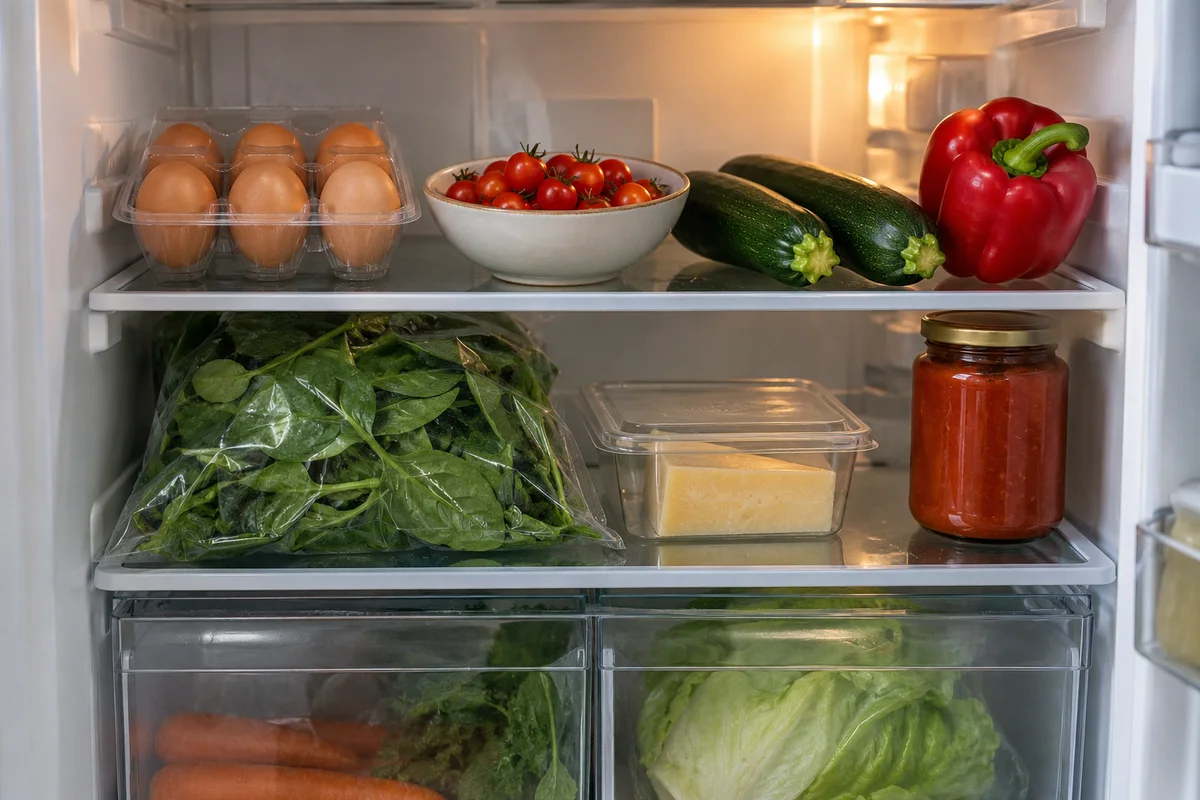
What can we cook from this fridge photo in 30 minutes?
Turn your own fridge photo into two realistic dinner options, then a timed cooking plan.
AI-generated example input, not a reader photo or tested meal plan. Confirm ingredients, amounts and food safety yourself. How to use your own photo →
I have attached a photo of my fridge. Help me make dinner in 30 minutes, including preparation, for [adults and children with ages]. First list the ingredients you can reasonably identify, separate uncertain items and ask me to confirm usable quantities. Do not guess the contents of closed containers, freshness, allergens or storage history. Wait for my confirmation before suggesting meals. My allergies or dietary requirements are [details], equipment [hob rings, pans, oven or microwave], and pantry ingredients [list]. After confirmation, offer two meals using the confirmed ingredients, clearly list any extras and let me choose. Then give quantities, parallel preparation steps and a realistic 30-minute timeline. If my constraints do not fit, explain what needs to change rather than promising an impossible dinner.
Fill in your details before copying
Make it yours: Attach your own clear photo in ChatGPT, Claude or Gemini if your app supports images. Check labels, storage and suitability yourself; do not use AI to decide whether questionable food is safe.
A useful follow-up
We choose option one, but have only one frying pan and no oven. Rework the order so dinner is ready together. Remove unconfirmed ingredients and give a fallback if preparation takes ten minutes longer.
02
Text
Rehearse a new dinner recipe before serving it to guests
A recipe rehearsal focused on actual kitchen bottlenecks.
I want to try [recipe text] before cooking for [guests and dietary requirements]. My equipment is [equipment], practice time [time] and approved ingredients [list]. Make a rehearsal plan to check timing, portions, equipment fit and steps I do not understand. Record what I actually observe rather than inventing success. Do not infer allergen safety or safe storage from appearance; flag handling questions for authoritative guidance. Give a short results sheet and ask which part of the dinner would be hardest to recover if it failed.
Fill in your details before copying
Make it yours: Use verified recipes and guest requirements; a trial does not establish allergy safety.
A useful follow-up
The sauce took twice as long as expected. Update the guest-day timeline using my measured result.
03
Text
Tell tested recipe changes apart from guesses in the comments
A recipe-comment review that distinguishes experience from speculation.
I want to cook this recipe [recipe text]. Here are selected comments I am permitted to share [comments with dates], my dietary requirements [requirements] and equipment [equipment]. Separate comments reporting an actual attempt from suggestions, questions and opinions. Identify which changes alter quantities, method or cooking time, without declaring them safe or successful for my kitchen. Return a short list of changes to consider with evidence and unresolved questions. Do not combine several untested changes into a guaranteed recipe. Ask which problem I am trying to solve before recommending a trial.
Fill in your details before copying
Make it yours: Use the original recipe and reliable handling guidance; a popular comment is not a safety source.
A useful follow-up
I only want to reduce sweetness. Keep unrelated changes out and identify the quantities that need a controlled trial.
04
Text
Prepare a cook-at-home meal kit from my friend's approved recipe
A recipient-approved meal-kit checklist with handling questions left visible.
I want to give a friend ingredients for this recipe [complete recipe they approve]. Their portions, dietary requirements and kitchen equipment are [confirmed details]; ingredients I can supply [list]. Make a packing and recipe-reference checklist with exact quantities from the recipe, separating items they already have and ingredients needing label checks. Do not guarantee allergen safety, shelf life or transport suitability; flag those questions for authoritative guidance and the recipient. Ask when and how the kit will be handed over before suggesting a practical preparation plan.
Fill in your details before copying
Make it yours: Use a recipe and ingredients the recipient has approved; packaging does not establish food safety.
A useful follow-up
They have no oven but approve this alternative recipe [recipe]. Rebuild the kit from that recipe instead of improvising unsafe adaptations.
05
Text
Translate a recipe without guessing the ingredient hidden behind a regional name
A recipe translation with regional ambiguities exposed.
Here is a recipe I am permitted to use [text], source region/language [details], cooking context [context] and ingredients I can identify [list]. Translate the instructions clearly while preserving quantities and sequence. Keep regional ingredient names alongside uncertain translations and list questions for a knowledgeable cook or reliable source. Do not silently substitute a different ingredient, invent temperatures or guarantee dietary suitability. Separate translation from adaptation and ask which unfamiliar term prevents me from shopping before producing an ingredient checklist.
Fill in your details before copying
Make it yours: Confirm unfamiliar ingredients and label requirements before buying or cooking.
A useful follow-up
A knowledgeable cook confirms this regional term [answer]. Update the translation without changing quantities or adding substitutions.
06
Text
Compare two versions of my soup with a simple blind taste test
A controlled home taste comparison and honest results sheet.
I want to compare two versions of this verified soup recipe [recipes and approved changes] for [adult volunteers who agree]. Dietary requirements and ingredient-label checks are [confirmed details]. Plan a small taste comparison using neutral sample labels, the same serving conditions and questions about flavour/texture rather than guessing which is healthier. Do not invent responses, guarantee food safety or prescribe handling outside authoritative guidance. Give a results sheet and ask which single recipe change I want to test before mixing several changes together.
Fill in your details before copying
Make it yours: Prepare both samples following reliable food-handling guidance and confirmed dietary requirements.
A useful follow-up
Here are the actual anonymous responses [responses]. Summarise preferences and disagreement without claiming the small group represents everyone.
07
Text
Plan who assembles each dinner plate so the garnish and vegetarian portions do not get mixed up
A practical dinner-plating plan with distinct portions clearly identified.
We are serving [approved menu] to [guest count], with confirmed vegetarian portions and dietary requirements [details], serving dishes [inventory] and helpers [availability]. Make a simple plating station plan and portion labels using only the recipes and guest requirements I provide. Do not invent allergen safety, substitute ingredients or use decoration absent from the approved dishes. Keep reliable food-handling instructions separate for the responsible cook to confirm. Ask which plates need to remain distinct before assigning the assembly steps.
Fill in your details before copying
Make it yours: Confirm dietary arrangements directly and follow authoritative handling guidance.
A useful follow-up
A helper cannot attend. Simplify the plating sequence without combining portions that must remain separate.
08
Text
Prepare ingredients for three dishes without chopping everything the same way
A combined preparation list that preserves each recipe's requirements.
Here are three verified recipes [complete text], quantities [quantities], available bowls and tools [inventory] and dietary arrangements we confirmed [details]. Build a preparation list grouped by ingredient while preserving the different cuts, quantities and uses each recipe requires. Keep separate portions visibly labelled and do not silently merge steps with different requirements. Do not invent food-handling advice or substitutions. Ask which ingredient appears in incompatible preparations before suggesting a shared prep step, and flag handling questions for reliable guidance.
Fill in your details before copying
Make it yours: Keep recipe references beside each quantity and follow authoritative handling guidance.
A useful follow-up
The onion is sliced for one dish and finely diced for another. Split the preparation amounts and check that the shopping total stays unchanged.
09
Text
Check whether my recipe needs the drained weight or the full weight on the tin
A recipe-to-pack quantity check with net and drained weights separated.
This recipe asks for [ingredient and quantity]. Here are the complete recipe wording and the product label's net weight, drained weight and serving information [text]. Explain which quantity the source explicitly requires and what remains ambiguous; show arithmetic only under clearly named assumptions. Do not guess the recipe author's intention, invent conversion factors or assume two brands have the same contents. Make a shopping-quantity check and ask whether the recipe uses the liquid before choosing which label figure applies.
Fill in your details before copying
Make it yours: Retain the full ingredient instruction, not just the number beside it.
A useful follow-up
The author confirms the liquid is discarded. Recalculate using the supplied drained weight and show any partial-pack amount.
10
Text
Help me cook along one step at a time instead of showing the whole recipe again
A paced cook-along using the chosen recipe, not a new invented method.
Here is the complete recipe I chose [text], its published safety and cooking instructions [text], equipment I have [list] and steps I find unfamiliar [list]. First check that I have the required ingredients and equipment, then present one preparation step and wait for my confirmation before continuing. Keep the original quantities and required checks visible at the relevant step. Do not invent food-safety rules, claim to see my kitchen or advance because a timer would have elapsed. Ask which step I am actually at before starting.
Fill in your details before copying
Make it yours: Keep the original recipe available and follow its verified safety instructions.
A useful follow-up
I completed the chopping but have not heated the pan. Resume from the real step rather than assuming cooking has started.
11
Text
Choose a weeknight recipe by hands-on work as well as total cooking time
A recipe comparison that separates active attention from elapsed time.
I am choosing between these complete recipes [texts] for an evening with [available time and interruptions]. Extract stated preparation, active cooking, unattended intervals and serving steps, citing the recipe. Mark unstated durations as unknown rather than guessing. Compare whether my actual equipment and attention fit each recipe; do not shorten required cooking or safe-handling instructions to make the schedule fit. Return a practical choice worksheet. Ask when I must leave the kitchen before evaluating the timing.
Fill in your details before copying
Make it yours: A short advertised cooking time may exclude preparation; check the complete instructions.
A useful follow-up
One recipe needs constant attention during my scheduled call. Mark the conflict and compare the other option without altering either method.
12
Text
Cook one mild dinner with spicy toppings for the people who want them
Serve different spice preferences without cooking two complete meals.
Plan dinner for [number of adults and children] using [ingredients], [equipment] and [minutes]. Some people want mild food and others want heat. Ask about dietary restrictions and ingredients nobody likes before proposing one shared mild base and optional toppings served separately. Give quantities, a timed preparation order and a short shopping list containing only missing ingredients. Show which steps can be shared and when portions separate. Do not assume removing a topping makes a meal safe for an allergy; flag ingredients and handling that need checking.
Fill in your details before copying
Make it yours: Spice preference and an allergy are different constraints. Describe both explicitly.
A useful follow-up
We only have two hob rings and one person does not eat dairy. Revise the cooking order and toppings without adding a second main dish.
13
Text
Pack a lunch that I can eat without a microwave at work
Plan a realistic lunch around your actual transport and storage options.
Help me assemble [number] work lunches from [available ingredients and package instructions]. I have no microwave, travel for [duration], and have [confirmed refrigeration and insulated-bag options]. Ask about allergies, portion preferences and preparation time. Suggest options that fit those constraints, with an assembly list, missing groceries and what to pack separately to prevent sogginess. Do not invent safe storage times or assume an ice pack guarantees safe temperatures. If my storage arrangements are unclear, mark the food-safety question for checking against authoritative local guidance before choosing perishable ingredients.
Fill in your details before copying
Make it yours: Tell the model whether a fridge is actually available, not just whether you own a lunchbox.
A useful follow-up
There is no fridge at the destination after all. Remove choices that depend on refrigeration and list the package instructions I must check for the replacements.
14
Files
Follow a recipe written in unfamiliar units without guessing the conversions
Keep the original measurements visible and identify where a conversion needs better evidence.
Help me follow this recipe [material] using my kitchen scales and measuring tools [details]. Ask which country's cup or spoon standard the recipe uses and which measurements are actually specified. Make a two-column ingredient sheet preserving every original quantity beside its converted quantity and unit. Explain rounding and mark unresolved measures. Do not treat a cup of flour as weighing the same as a cup of water or invent the weight of a loosely described ingredient. If a conversion depends on density, packing or the author's convention, ask for a reliable ingredient-specific reference or keep the original measure.
Fill in your details before copying
Make it yours: Keep the original recipe beside the conversion sheet so errors are easier to spot.
A useful follow-up
The recipe only says 'one cup of chopped nuts' and does not name a cup standard. Leave that conversion unresolved and show exactly what I should ask the author.
15
Text
Plan a family dinner when the oven stops working
Replace the oven-dependent parts of a meal without assuming another appliance cooks them identically.
Our oven is unavailable and I need dinner for [people] in [minutes]. My planned menu, ingredients, dietary restrictions and working equipment are [details]. Ask what is already prepared and what food-handling instructions apply. Suggest a revised meal that uses only the confirmed working equipment, with a short preparation order and any genuinely missing groceries. Do not convert an oven recipe to a different appliance by inventing a temperature or time, or suggest using a faulty appliance. Keep package and reliable recipe instructions separate from assumptions, and flag any unresolved cooking-safety question before recommending that component.
Fill in your details before copying
Make it yours: List what still works and the capacity of each appliance; 'no oven' does not mean every other tool is available.
A useful follow-up
The hob works but we have only one saucepan. Simplify the menu around that constraint instead of giving me three things to cook at once.
16
Text
Organise a bring-a-dish dinner so six guests do not all arrive with dessert
Turn agreed contributions into a balanced menu and a short list of missing dishes.
Plan a bring-a-dish dinner for [people, ages and confirmed dietary requirements] using guests' actual offers [anonymised list]. My serving space, equipment, budget and arrival window are [details]. Ask which contributions are confirmed and which guests want suggestions. Make a contribution table with portions, preparation state, serving needs and questions for each contributor. Identify menu gaps without assigning anyone work they have not accepted. Do not infer allergen safety, transport temperatures or safe storage times. Keep ingredient and food-handling questions for direct confirmation before including uncertain dishes. Draft one friendly coordination message, not invitations sent on my behalf.
Fill in your details before copying
Make it yours: Ask whether a dish arrives ready to serve or needs your oven; that changes what is feasible.
A useful follow-up
Three guests want to reheat dishes but only one oven is available. Ask for agreed ready-to-serve alternatives and show unresolved equipment clashes rather than inventing reheating times.
17
Files
Choose a useful replacement when a recipe ingredient is missing at the supermarket
Check what an ingredient does before changing the recipe or shopping list.
This recipe needs [missing ingredient and quantity], but the shop offers [actual alternatives with labels]. Use the recipe text, my dietary requirements and cooking equipment [details]. Explain the ingredient's likely role and distinguish that inference from explicit recipe guidance. Ask whether I prefer a verified adaptation, a changed dish or postponing it. Compare only supplied alternatives for flavour, texture, preparation and labelled ingredients; flag unknown ratios or recipe-dependent behaviour instead of inventing an exact swap. Do not call a replacement allergy-safe or assume similarly named products have the same ingredients. Return a revised shopping list only after I choose an option.
Fill in your details before copying
Make it yours: A garnish and a structural baking ingredient need different kinds of substitution evidence.
A useful follow-up
The missing ingredient is essential to setting the dessert. Do not guess a replacement ratio; help me choose another documented recipe using the ingredients I can actually buy.
18
Files
Compare the cost per portion of two dinners using my actual shop prices
Separate the ingredients used in a meal from the cash needed to buy whole packs.
Compare these two recipes [ingredients, quantities and serving counts] using my dated shop prices, pack sizes and usable pantry amounts [material]. Ask which ingredients I already own and whether optional extras should count. Show ingredient-use cost per batch and portion separately from the checkout cost of whole packs, with formulas and leftover quantities. Keep incompatible units and unknown weights unresolved. Do not invent current prices, assume unused ingredients will be eaten or call the cheaper recipe nutritionally equivalent. Return a transparent comparison and the missing information that could change it, not a purchase or dietary recommendation.
Fill in your details before copying
Make it yours: A recipe can use a small fraction of a pack while still requiring you to buy the whole pack today.
A useful follow-up
One recipe needs a sauce I do not own and may not use again. Show its full checkout cost alongside the amount used, without treating the remainder as a guaranteed future saving.
19
Files
Save the version of a recipe that actually worked in my kitchen
Turn your recorded cooking changes into a reusable recipe card with its original reference intact.
Create a personal recipe card from this original recipe and my notes from the version I actually cooked [material]. Ask which changes I made, the equipment used, portions produced and what I observed. Keep original quantities beside confirmed changes, preserve important preparation instructions and mark any timing I did not record. Separate my preference from a claim about why the change worked. Do not invent missing cooking temperatures, food-safety instructions, storage life or an untested substitution. Return a dated card for my review with a short change log and questions to resolve before repeating it; keep the original author and source reference.
Fill in your details before copying
Make it yours: Write down what you changed soon after cooking; memory can blur an intended change with what you actually did.
A useful follow-up
I planned to halve the spice but cannot remember whether I did. Keep that quantity unconfirmed and do not label the card a reliably reproduced mild version.
20
Text
Set out serving dishes before dinner so I do not discover a missing bowl at the table
Match a confirmed menu to the serving items and table space you actually have.
Make a serving setup for this confirmed dinner menu and guest count [details] using my actual plates, bowls, serving utensils, table measurements and available surfaces [inventory]. Ask which dishes arrive ready to serve and whether guests have access needs or separately confirmed dietary arrangements. Assign a suitable existing serving item and utensil to each dish, flag missing pieces and show a simple table or sideboard layout. Do not infer heat resistance, allergen separation, safe holding temperatures or furniture load capacity. Leave those checks explicit for me. Return a setup checklist and a lower-clutter alternative, not extra purchases or unverified food-handling instructions.
Fill in your details before copying
Make it yours: Include utensils and space for guests' plates, not just a bowl for each recipe.
A useful follow-up
The salad bowl takes most of the table space. Move appropriate serving items to the measured sideboard and show what guests still need within reach, without assuming every dish can stand there indefinitely.
21
Files
Check my online grocery basket against the recipes before I pay
Catch missing ingredients, duplicate packs and mismatched quantities before checkout.
Compare these recipes, required portions, usable pantry amounts and current grocery basket [redacted material]. Ask whether every recipe is still planned and which optional ingredients I want. Trace each basket item to a recipe or a separately confirmed household need; show required amounts, pack amounts, duplicates and missing ingredients without silently combining incompatible units. Keep unknown weights and unreadable products unresolved. Do not assume a similarly named item has the same ingredients or meets dietary requirements. Return a proposed basket correction list for my review, with any changed recipe quantities visible; do not edit the basket, place the order or invent current prices.
Fill in your details before copying
Make it yours: Include pack sizes; three packs do not tell the model how much food you will receive.
A useful follow-up
One recipe was cancelled after I added its ingredients. Remove only items no other recipe or confirmed household need uses, and show the remaining shared quantities.
22
Files
Check supermarket delivery substitutions before they derail tonight's dinner
Compare the delivered order with the intended recipes and identify decisions you need to make.
Use my redacted grocery delivery list, substitutions, actual package labels and tonight's chosen recipes [material]. Ask which delivered ingredients I have physically confirmed and any dietary restrictions. Show what arrived as ordered, what changed and which recipe steps depend on missing or different products. Do not treat a replacement as equivalent because its name or price is similar, declare allergen suitability or invent cooking conversions. Offer the smallest recipe-plan changes using only ingredients I confirm suitable, keeping unresolved food-safety questions for reliable guidance. Return a decision checklist and a draft factual shop enquiry where needed, not an automatic refund claim or order change.
Fill in your details before copying
Make it yours: The replacement item on the delivery note may still need checking against its actual label.
A useful follow-up
The delivered beans are dried, but my recipe specifies canned beans and dinner is soon. Flag the mismatch and help choose a different feasible meal rather than inventing a quick conversion.
23
Files
Understand the unfamiliar steps in a recipe before I start cooking
Turn unclear cooking language into questions and a preparation checklist grounded in the recipe.
Help me understand this recipe [full text and source] before I cook it with [experience and equipment]. Ask which words or steps I find unfamiliar. Explain those terms in plain language, distinguish a general explanation from the recipe's exact instructions and list ingredients or tools that need preparing first. Flag missing quantities, settings, pan dimensions or ambiguous timing instead of filling them in. Keep food-safety decisions and unclear cooking requirements for the recipe author or authoritative guidance. Return a short glossary, a before-starting checklist and questions to resolve, not an invented replacement method or a promise that I can finish within the advertised time.
Fill in your details before copying
Make it yours: Share the whole method; an unfamiliar word can mean something different in the surrounding steps.
A useful follow-up
The recipe says 'reserve some cooking water' but gives no amount. Keep that amount unresolved and show where it is used later so I can ask a precise question.
24
Images
Turn my handwritten family recipe into clear cooking steps
Transcribe this photo of a family recipe. Keep original quantities, units and wording in a first section and mark anything unclear as [unreadable]. Do not silently correct or fill gaps. Ask me to confirm uncertain ingredients, oven settings, pan sizes, timings and quantities before making a clean recipe. After confirmation, produce an ingredient list, equipment list and numbered steps for the original serving count. Separate my confirmed additions from the original text. Flag missing cooking or safety details for a reliable recipe or official guidance rather than guessing them.
Make it yours: Use a clear crop with no family contact details. Supply another photo if a fold or stain hides a word.
A useful follow-up
The handwritten quantity was 150 g, not 750 g. Correct the transcription and identify every step affected; keep the original serving count.
25
Text
Plan a cooking evening where six friends can all take part
Plan a shared cooking evening for [people, experience levels and confirmed dietary requirements] in my kitchen [work surfaces, hobs, oven, pans and utensils]. We choose these supplied recipes [recipes, portions and timing]. Split the work into sensible stations, with a role for each person, equipment handovers and a cleanup plan. Identify collisions and tasks that must wait. Keep allergy and food-safety requirements visible and use verified recipe guidance, not invented holding times. Ask for missing recipe or equipment details before producing the final timetable.
Fill in your details before copying
Make it yours: Include whether your friends want to learn or just help; six simultaneous cooks may be less useful than rotating pairs.
A useful follow-up
Two friends arrive 30 minutes late. Reassign tasks without changing the menu or leaving them out of the cooking.
26
Files
Make a bake-sale ingredient and allergen information sheet from our recipes
Use these confirmed bake-sale recipes, ingredient packaging labels and planned batch sizes [material]. Make a preparation shopping list and a draft information sheet for each item showing ingredients and allergens explicitly identified in the supplied labels. Preserve sub-ingredients and supplied precautionary statements. Flag missing labels, recipe substitutions and cross-contact questions; do not declare anything allergen-free or safe for a particular child. Ask the organiser for applicable school or event requirements before finalising. Keep prices, batch quantities and portions separate, and do not invent shelf-life advice.
Fill in your details before copying
Make it yours: Use current labels for the actual ingredients you will buy, not a generic ingredient list from the internet.
A useful follow-up
We replaced the chocolate chips with a different brand. List which sheets need checking and do not reuse the old label's allergen information.
27
Text
Plan five family dinners around our school and sports timetable
Plan dinners for Monday to Friday for [adults] adults and [children with ages]. Our timetable is [home times and activities], budget [amount and currency], dietary requirements [details], and equipment [hobs, oven and other equipment]. Ask about allergies first. Give a feasible menu, quantities and active cooking time for each day, using these pantry ingredients [inventory]. Put the quickest dinner on our busiest night. Flag food-storage questions for reliable guidance rather than inventing safe storage times.
Fill in your details before copying
Make it yours: Include who can cook and how much fridge space is available.
A useful follow-up
Wednesday practice moves earlier. Replace only that dinner and update the ingredients needed.
28
Files
Turn these three recipes into one supermarket shopping list
Use these uploaded recipes with ingredient quantities and serving counts. I need [portions] of each and already have [pantry inventory with amounts]. Scale and combine compatible ingredient units, subtract what I have and group purchases by supermarket aisle. Show required quantity separately from purchase quantity where package sizes are supplied. Flag unclear weights, optional ingredients and incompatible units instead of guessing. Check each shopping item back against a recipe.
Fill in your details before copying
Make it yours: Include recipe text if a photograph is unreadable; do not upload shopping-account details.
A useful follow-up
Show the arithmetic for onions, rice and milk and check whether any ingredient was counted twice.
29
Text
Can this dinner menu fit in my small oven and two pans?
Review this dinner menu [recipes, portions and proposed serving times]. I have two hobs, [pan sizes], and one oven with internal dimensions [dimensions] and [usable shelves]. The dishes and trays are [sizes and cooking requirements from recipes]. Build an equipment timeline and flag clashes, incompatible oven temperatures and batches that will not fit. Suggest the smallest menu changes. Do not invent cooking or holding instructions; mark safety details to verify against reliable food guidance.
Fill in your details before copying
Make it yours: Give tray dimensions as well as oven capacity in litres.
A useful follow-up
One hob stops working. Which dish should we replace to keep the dinner manageable?
30
Text
Make a dinner everyone can share when three guests are vegetarian
We are [guest count], including three vegetarians and [children with ages]. Dietary details and allergies are [confirmed list]. Suggest a shared dinner with a vegetarian main rather than treating vegetables as the entire meal, plus optional extras served separately. Work within [budget, time and equipment]. Give ingredient quantities, serving plan and questions to confirm with guests about stock, cheese and other ingredients. Do not label a dish allergy-safe or vegan without checking its actual ingredients.
Fill in your details before copying
Make it yours: Vegetarian, vegan and allergy requirements are different; ask guests what they need.
A useful follow-up
One vegetarian guest also avoids dairy. Adapt the shared main and update only the changed purchases.
31
Text
Use my fridge inventory before I buy more groceries
Here is my fridge and cupboard inventory with amounts, dates and storage information I actually know: [list]. Plan [number] meals for [people], avoiding [dietary restrictions]. Separate ingredients I can use from those needing a safety check; do not decide that questionable food is safe from its appearance or smell. Suggest dishes only with confirmed usable ingredients. Give a short list of genuinely missing items and explain where leftovers could be planned, subject to reliable storage guidance.
Fill in your details before copying
Make it yours: Do not use an AI answer to override labels or official food-safety advice.
A useful follow-up
Remove every dish requiring more than two new ingredients and recalculate the shopping list.
32
Files
Scale this lasagne for twelve without assuming it fits one dish
The uploaded lasagne recipe serves [original servings]. I need twelve portions, including [children with ages], using [dish dimensions and oven shelf space]. Scale the ingredient quantities with a visible multiplier, ask about dietary requirements and flag ambiguous measures. Suggest how to divide the mixture between dishes. Do not multiply oven temperature or cooking time by the portion factor; list the recipe and safety checks needed for changed dish depth and batch size.
Fill in your details before copying
Make it yours: Supply the recipe's actual measurements and equipment, not only a photo of the finished meal.
A useful follow-up
Only one dish fits in the oven. Suggest a different menu or serving plan instead of pretending both can cook together.
33
Text
Plan a picnic shopping list for six adults and four children
Create a picnic menu and shopping list for six adults and four children aged [ages]. We travel [duration], eat at [time], have [cooling equipment], and must accommodate [allergies and diets]. Budget is [amount]. Suggest manageable portions, utensils and waste bags. Ask about refrigeration and weather before choosing perishable dishes; do not invent safe unrefrigerated times. Separate food purchases from equipment and give a simpler option if adequate cooling is unavailable.
Fill in your details before copying
Make it yours: Confirm food-safety and allergen arrangements independently.
A useful follow-up
Rain moves the picnic indoors. Keep the groceries and change only the serving and equipment plan.
34
Text
Cook dinner for two with only a microwave and kettle
I need dinner for two using only a microwave [power], kettle, [microwave-safe containers] and these ingredients [list with preparation state]. Time [minutes], budget [amount], allergies and diets [details]. Propose two feasible options and tell me what equipment or ready-cooked ingredients are essential. Follow supplied package instructions rather than inventing cooking settings. Do not suggest putting unsuitable containers in the microwave or using the kettle as a cooking pot.
Fill in your details before copying
Make it yours: Give equipment instructions and check labels yourself; do not assume uncooked ingredients can be made safe quickly.
A useful follow-up
We have no fridge. Remove options that depend on storing leftovers.
35
Text
Make a Sunday batch-cooking plan without filling my entire freezer
Help plan [number] weekday meals for [household], with [hours] available on Sunday, [freezer space and container sizes], and [equipment]. Use [preferred recipes and restrictions]. Give a batch sequence, portions, container allocation, labels and a grocery list. Flag cooling, freezing, reheating and storage questions to check against reliable guidance instead of inventing times. Do not include more portions than the confirmed storage capacity allows.
Fill in your details before copying
Make it yours: Measure the available space and identify which meals will be eaten fresh.
A useful follow-up
Halve the freezer space and replace the meals that no longer fit with quick fresh dinners.
36
Text
Plan breakfast and lunch for a weekend house with ten guests
We share a holiday house from [arrival] to [departure] with [adults] adults and [children with ages]. We need [breakfasts and lunches], diets and allergies [details], budget [amount], fridge capacity [details] and cooking equipment [details]. Build a simple meal plan, portion assumptions, combined shopping list and rotating preparation tasks. Separate arrival-day purchases from later shopping. Check whether the fridge and serving equipment can hold the proposed quantities.
Fill in your details before copying
Make it yours: Confirm preferences and dietary requirements instead of assuming every guest eats the same amount.
A useful follow-up
Two guests arrive a day later. Adjust quantities and tasks without rewriting unrelated meals.
37
Text
Make dinner with my chickpeas, spinach and rice in 25 minutes
I have chickpeas [amount and canned or dried], spinach [amount], rice [type] and these other ingredients: [list]. Make a dinner for [people] using [equipment] within 25 minutes if feasible. Ask about allergies and dietary requirements before proposing the meal. Give quantities, a short sequence and substitutions. Do not assume dried chickpeas or every rice type can cook in that time; suggest a feasible alternative if needed. Use only ingredients I confirm or clearly label additions.
Fill in your details before copying
Make it yours: Check labels for allergens and independently follow appropriate food-safety guidance.
A useful follow-up
I have only one hob. Reorder the steps or suggest a simpler version that still fits my equipment.
38
Text
Plan when to cook each dish using my actual oven and hobs
Plan the cooking sequence for this menu: [menu]. We have [equipment], [people cooking] and must serve at [time]. Identify competing oven or hob needs and suggest a feasible preparation order. Preserve food-safety requirements and flag anything needing an authoritative check.
Fill in your details before copying
Make it yours: Provide preparation times from the actual recipes.
A useful follow-up
What can be simplified without changing the main meal?
39
Text
Make tomorrow's dinner from the leftovers I can safely use
Suggest a second meal using [leftover ingredients and quantities]. Account for [preferences, equipment and time]. Do not assume food is safe based only on appearance. Separate recipe ideas from storage or safety questions needing reliable guidance. Give substitutions and a short extra shopping list.
Fill in your details before copying
Make it yours: Check safe storage and use-by guidance independently.
A useful follow-up
Which option uses the most leftovers with the fewest extra ingredients?
40
Text
Why did my cake sink, and what should I change next time?
My cake sank after baking. Here are the recipe, ingredient amounts, tin dimensions, oven settings, timings and what I observed [notes]. List plausible explanations that fit the observations and questions that would help distinguish them. Suggest one recipe-based change to try next time rather than changing everything at once. Do not decide that the cake is safe to eat or invent cooking requirements.
Fill in your details before copying
Make it yours: Include the actual recipe and measured settings; a photo alone cannot establish the cause.
A useful follow-up
What should I observe next time to distinguish the two leading causes?
41
Text
Plan dinners that reuse ingredients
A practical menu and a shopping list with less duplication.
Plan [number] dinners for [people] using [ingredients] and a [budget] shopping budget. Respect [allergies, preferences and equipment]. Reuse ingredients across meals and prioritise perishables. Give quantities, approximate active cooking time and one consolidated shopping list. Clearly label pantry assumptions.
Fill in your details before copying
Make it yours: Specify quantities already available and check every ingredient against allergies yourself.
A useful follow-up
Replace dinner three with a meal needing less than 15 minutes of active preparation.
42
Text
Scale a recipe without blindly multiplying everything
An adjusted recipe and a feasible preparation schedule.
Adapt this recipe from [servings] to [new servings]: [recipe]. Scale ingredient quantities, identify quantities needing judgement and explain equipment or batch-size limits. Suggest what to prepare ahead and how to stage the cooking for serving at [time]. Keep food-safety questions explicit rather than guessing.
Fill in your details before copying
Make it yours: Include pan sizes and the original method as well as the ingredient list.
A useful follow-up
We only have one oven. Revise the schedule around that constraint.
43
Suggest three dinners from the ingredients I already have
Suggest three possible dinners for [people] using these ingredients and quantities [inventory]. I have [time and equipment] and need to account for [allergies and preferences]. Ask about missing information before choosing a recipe. Show extra ingredients separately and do not assume questionable leftovers are safe. Use only ingredients I confirm usable and flag cooking or storage questions for reliable guidance.
Fill in your details before copying
Make it yours: Include quantities and the preparation state, such as dried or canned beans.